Why Your Vision and Plan are Divorced (And How to Force a Reconciliation)
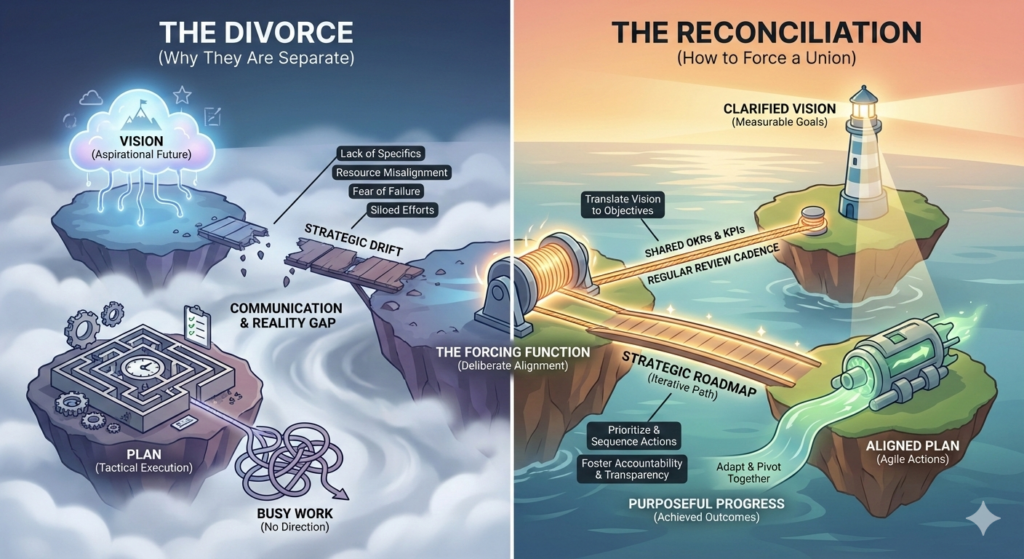
The “Offsite Hangover” is real.
You know the feeling. You spent three days at a luxury retreat with your executive team. You hired a graphic facilitator to draw your “North Star” on a whiteboard. You wordsmithed a Vision Statement that made everyone nod solemnly. You left on Friday high-fiving, convinced you had finally aligned the ship.
Then, Monday morning happened.
The “urgent” emails buried the “important” strategy. Sales went back to selling what they know, not what you’re building. Product ignored the new roadmap to patch old bugs. By Wednesday, your shiny new Strategic Plan was just a PDF buried in a shared drive—a “Zombie Strategy” that looks alive on paper but is dead on the floor.
Standard business advice tells you to “over-communicate” or “cascade the goals.” This is nonsense. You cannot PowerPoint your way out of a misalignment problem.
The disconnect isn’t communication. It’s cowardice.
Most strategic misalignment is not a failure of logic; it is a failure of nerve. It happens when the Vision (where we are going) demands a sacrifice that the Plan (what we are doing) is too afraid to make.
This is where The THINK Process enters the room. We don’t “cascade.” We calibrate.
The Pivot: From Consensus to Calibration
When I deploy The THINK Process, I am not looking for agreement. I am looking for the lie. The gap between Vision and Plan is almost always filled with “phantom projects”—initiatives that everyone knows don’t fit the future, but no one has the guts to kill because they belong to a powerful executive.
To fix this, we don’t start with a spreadsheet. We start with the THINK Framework.
Phase 1: The Mindset (THINK)
We recently worked with a mid-sized logistics firm—let’s call them Apex. They had a bold new Vision: “To become the premier AI-driven logistics partner.” Yet, their Strategic Plan allocated 70% of their budget to maintaining manual warehouses.
We didn’t touch the budget yet. We touched the leadership psyche.
- Honesty: Be truthful about intentions and priorities. We forced the CEO to admit a hard truth: The manual warehouses were run by his co-founder. The “AI Vision” was just marketing fluff to attract investors, but he had no intention of upsetting his partner. You cannot align a fake Vision.
- Nerve: Trust instincts; embrace uncertainty. We challenged the team: “If you are truly ‘AI-driven,’ which of your current top-performers becomes obsolete?” Silence. That silence is where the misalignment lives. Real alignment requires the nerve to tell loyal people their skills are no longer the priority.
Phase 2: The Intervention (PROCESS)
Once the emotional debris was cleared, we moved into the PROCESS phase. This is not a democratic brainstorming session. It is a surgical removal of the old way of doing things.
Input: A Strategic Plan with 45 “Priority 1” initiatives (which means zero priorities) and a Vision Statement that sounded like a hallmark card.
The Black Box:
We initiated the Pinpoint the Unknowns and Reveal the Root Cause products. We locked the executive team in a room and stripped the Strategic Plan of every initiative that didn’t have a direct, mathematical link to the new Vision. We didn’t ask “Is this a good idea?”; we asked “Is this Vision-critical?”
The middle of this process is messy. It involves hurt feelings, threatened egos, and the dismantling of empires. It is a rigorous, expert-led intervention where we force leaders to trade “good” things for the “only” thing.
Output: A Strategic Plan with only 4 initiatives. Everything else was cut or put on maintenance mode.
The “Human Gap”
Data can identify a problem, but it cannot soothe an ego.
During the Options and Integration phase at Apex, the Head of Sales hit a wall. The data clearly showed that his “high-touch” sales model—wining and dining clients—was incompatible with the new “self-service AI” Vision. He had the numbers to prove his model worked today, but the Vision was about tomorrow.
The spreadsheet said “Fire the sales team.” Logic said “Keep the revenue.”
This is the Human Gap. The client (the CEO) froze. He couldn’t choose between his friend and his future.
I had to intervene. I didn’t use a chart. I used the Tolerance principle. I pulled the Sales Head aside and facilitated a “Legacy Transition.” We didn’t fire him; we redefined his role from “Builder” to “Mentor,” tasking him with transferring his relationships to the new digital system. It required an external guide to bridge the gap between cold strategy and human dignity.
“Alignment isn’t an announcement; it’s an audit of your own integrity. If your budget doesn’t look like your vision, you are lying to yourself.”
The Technical Balance: The Gyroscope Effect
Think of your company like a modern aircraft. You can’t just point the nose and hope. You need a Gyroscope—a device that detects deviation from the path instantly.
- Gyroscope (n): In strategic terms, a mechanism or ritual that forces a comparison between current actions (The Plan) and the desired destination (The Vision), correcting “drift” before it becomes a detour.
Most companies lack a gyroscope. They set the Vision in January and check it in December. By then, they are 500 miles off course.
The Result
After the painful cuts, Apex Logistics looked smaller but moved faster.
- Misalignment: Eradicated. Every dollar spent was an “AI dollar.”
- Turnover: They lost two executives who couldn’t adapt. (This is a success, not a failure).
- Outcome: Six months later, they launched their new platform. It wasn’t perfect, but it was aligned. The market rewarded them with a 40% valuation increase because investors saw a company that actually did what it said it would do.
Key Takeaways
- Honesty First: If you aren’t willing to fire the “cash cow” to feed the “calf,” your Vision is a lie.
- Kill the Phantom Projects: Use the Reveal the Root Cause step to find and eliminate “pet projects” that don’t serve the Vision.
- The Gyroscope: You need a monthly mechanism to calibrate Plan vs. Vision, not an annual one.
- Embrace the Human Gap: Alignment hurts feelings. Don’t let empathy for an individual sabotage the future of the collective.
Call to Action
Does your Strategic Plan look like a “Wish List” of everything you want to do, rather than a focused attack on where you need to go?
You are likely suffering from Strategic Drift.
It is time to stop cascading and start calibrating. Contact us today for a “Vision-Reality Audit.” We will help you find the courage to align your actions with your ambition.