Why Your Managers Are Failing as Coaches (And How to Fix It)
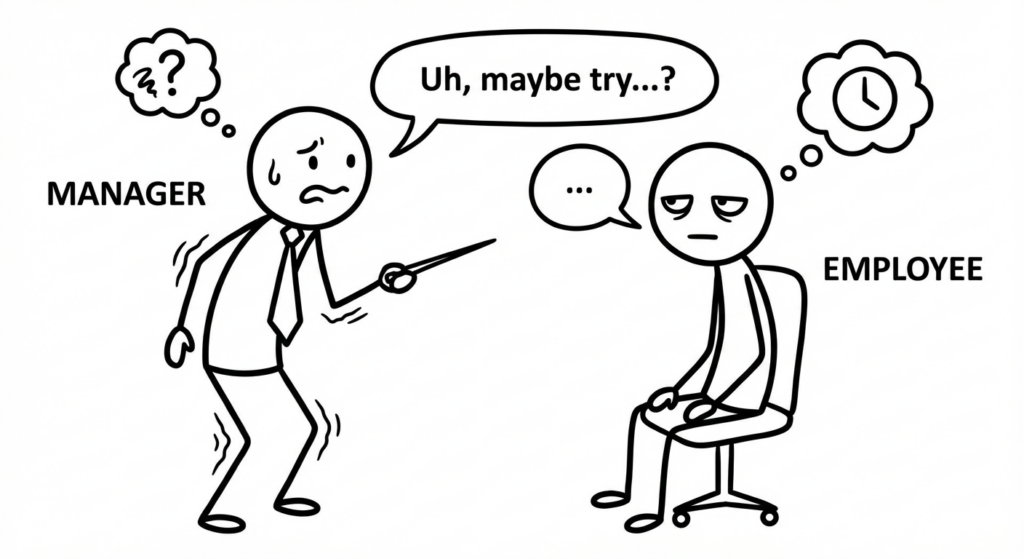
The “Manager Squeeze” is real, and it’s costing you billions.
According to recent Gallup data, global manager engagement has plummeted to just 27%. Yet, these same exhausted managers account for 70% of the variance in their team’s engagement. We promote high-performers into leadership based on technical competence, hand them a generic “coaching framework,” and expect them to magically transform their teams.
It is a setup for failure.
Most organizations treat coaching as a script—a series of “how-to” conversations to fix underperformance. But coaching is not a script. It is a forensic investigation into human behavior. When leaders fail to coach effectively, it isn’t because they lack a handbook. It’s because they lack the proprietary mindset required to navigate the psychological complexity of their people.
The Failure of Standard Advice: The “Sandwich” Is Stale
You have likely heard the standard advice: “Use the Feedback Sandwich” (compliment, critique, compliment) or “Ask open-ended questions.”
This is Performance Theatre.
Employees can smell the “technique” a mile away. When a leader relies on a checklist, the interaction feels manipulative, not supportive. The “Feedback Sandwich” teaches managers to hide the truth inside a layer of fluff. The result? The employee hears the fluff, ignores the critique, and the behavior persists.
Analogy: Imagine a structural engineer trying to fix a cracking foundation by applying a fresh coat of paint. The wall looks better for a day, but the house is still sinking.
Technical Definition: Transactional Coaching (attempting to modify behavior through external rewards or corrections) vs. Transformational Coaching (altering the underlying beliefs and drivers that cause the behavior).
The Pivot: The THINK Process
True coaching requires a departure from “fixing” and an entry into “understanding.” We do not teach leaders what to say. We teach them how to think before they ever open their mouths.
This is where The THINK Process distinguishes itself. It is not a conversation guide; it is a diagnostic operating system for the leader’s mind.
The Application: The Case of the “High-Performing” Toxic Leader
The Client: “Sarah,” a VP of Operations at a mid-sized logistics firm.
The Problem: “Mark,” her Director of Logistics. Mark was a numbers genius—he hit every KPI—but his team was in revolt. Turnover was 40% higher in his division.
The Failed Approach: Sarah had tried “standard coaching.” She held weekly 1:1s. She gave him “constructive feedback” about his tone. She used the “Sandwich.” Mark would nod, agree, and then go right back to bulldozing his staff.
The Intervention:
We did not give Sarah a script. We initiated the Honesty Phase of the THINK framework.
The “Step 1” Barrier:
The first step of The THINK Process is deceptively difficult because it requires the leader to stop lying to themselves. When we asked Sarah what her goal was with Mark, she gave the corporate answer: “I want to help him develop soft skills.”
We pushed back. That was a lie. Her actual goal was: “I want him to stop causing me headaches so I don’t have to fire my top performer.”
Until Sarah admitted her Intention was self-preservation, not development, she was coaching from a place of fear. You cannot coach someone you are afraid of.
The “Black Box” Protocol:
Once Sarah achieved Honesty and reset her Intention, we entered the Pinpoint the Unknowns product of the PROCESS framework.
- Input: A messy collection of complaints, high KPI reports, and exit interview data.
- The Intervention: We stripped away the “personality conflict” narrative and looked for the structural disconnect.
- Output: The realization that Mark’s aggression was a defense mechanism against a chaotic, undefined promotion structure Sarah herself had created.
The “Human” Moment
Here is where the data failed. The engagement survey data said Mark was the problem. The KPI data said Mark was the hero. Logic dictated a “Performance Improvement Plan” (PIP).
But during a session, Sarah hesitated. She looked at the PIP paperwork and said, “This feels like a betrayal. I created the chaos he’s trying to control.”
This was the Human Gap. A generic consultant would have said, “Follow the data. Put him on the PIP.”
We said: “Trust your Nerve. If you built the chaos, you must own it before you judge him.”
Sarah didn’t put Mark on a PIP. She apologized to him. She admitted she had valued his “bulldozing” when it saved the quarter, only to punish him for it now. That moment of vulnerability—not a “coaching tactic”—broke the deadlock.
The Result
Mark didn’t turn into a teddy bear overnight. But the dynamic shifted.
- Metric: Within six months, turnover in Mark’s division dropped by 18%.
- Transformation: Mark stopped hiding behind aggression because he no longer felt he had to “save” the department from Sarah’s lack of structure.
- The Shift: Sarah stopped “managing” Mark and started partnering with him.
“You cannot read the label when you are inside the jar. A leader’s inability to see their own role in a problem is the single biggest barrier to effective coaching.”
Key Takeaways
- Intention Before Action: If you are coaching to “fix” a problem for your own comfort, you have already failed. You must coach for the person, not the pain point.
- Process Over Scripts: Ditch the “Feedback Sandwich.” Use the Pinpoint Phase to identify if the behavior is a symptom of a systemic issue.
- The Mirror Test: Often, the “difficult employee” is reacting to the leader’s lack of clarity. Honesty requires you to audit your own leadership first.
- Nerve is Essential: It takes more courage to apologize to a subordinate than to reprimand them.
Is Your Leadership Team Ready?
Most organizations are not ready for this level of rigor. They prefer the “check-the-box” workshops that feel good but change nothing.
If you are tired of the “Advice Trap” and are ready to dismantle the dysfunction in your leadership structure, it is time to assess your readiness.