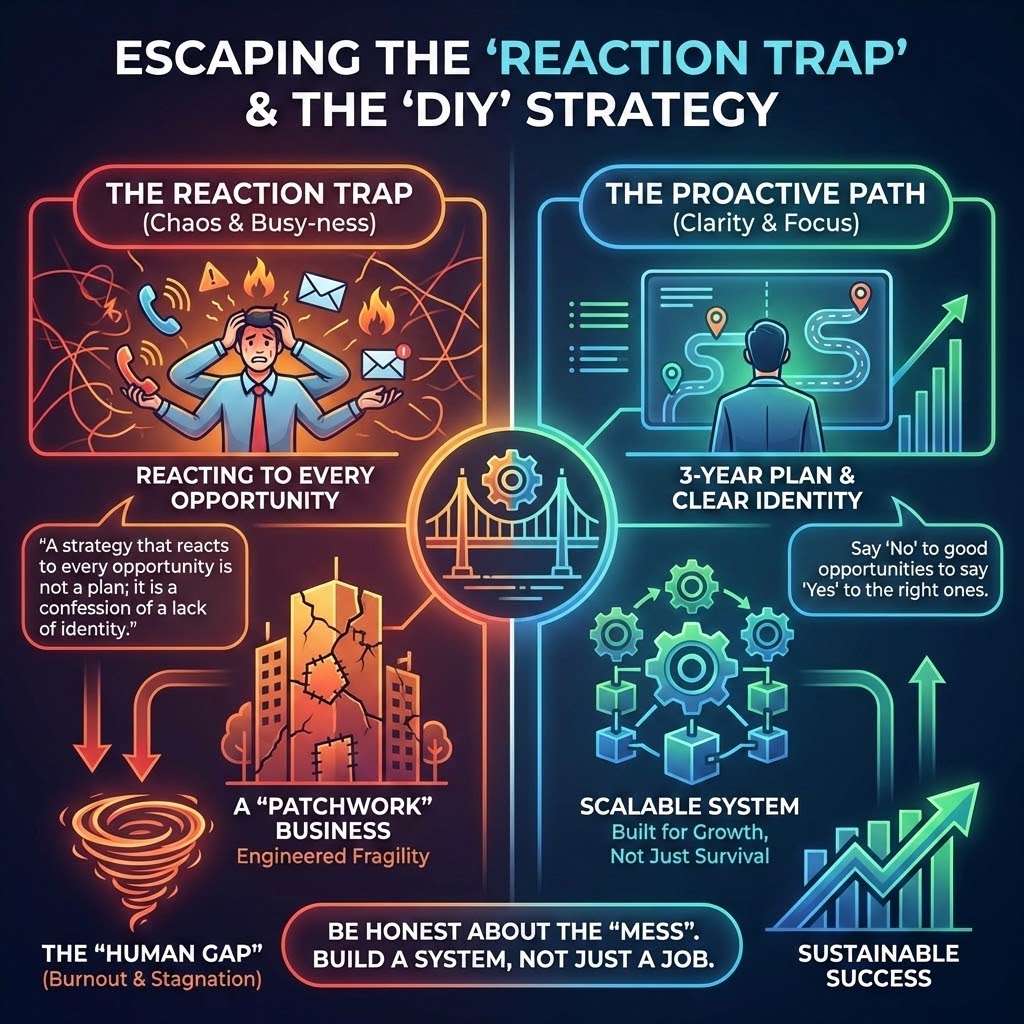
Your Strategic Plan Is NOT A To-Do List
You are a specialist in the nonprofit sector, a master of grant writing and program development. But lately, you feel less like an architect and more like a firefighter. One week you are drafting a federal grant for youth literacy; the next, you are designing a community health initiative because a potential contract landed in your inbox.
You tell yourself you are pivoting and staying agile. In reality, you are experiencing fragmentation. Research shows that over 40% of solopreneurs cite time management and “handling everything alone” as their primary cause of burnout. Like a ship without a rudder, you are moving fast, but you aren’t necessarily moving toward a destination.
The Illusion of the DIY Strategy
Standard business advice tells you to “just say no” or “write a 3-year plan.” If it were that easy, you would have done it already. DIY solutions fail because they assume you can be objective about your own chaos. In the nonprofit world, we often fall into the Scarcity Mindset—a psychological state where the fear of missing a contract overrides the logic of your long-term mission.
“A strategy that reacts to every opportunity is not a plan; it is a confession of a lack of identity.”
The THINK Process: A Professional Intervention
When a high-performing solopreneur in nonprofit management came to me, his business was a patchwork quilt of disconnected projects. He was profitable but exhausted, moving in five directions at once. We didn’t just organize his calendar. We initiated The THINK Process.
1. The “Step 1” Barrier: The Honesty Audit
We began with the Honesty Phase. This is the hardest part of the methodology. Most leaders lie to themselves here, claiming every project is mission-critical. Without an objective external facilitator to hold the mirror up, you will continue to justify the busy-ness. My client had to admit that 30% of his contracts were ego-driven or fear-based, not based on impact.
2. Cultivating the Mindset (THINK)
We moved into the Tolerance and Nerve phases.
- Tolerance required him to sit with the ambiguity of not knowing where his next check would come from if he stopped chasing every lead.
- Nerve was the calculated risk to decline a lucrative grant-writing contract that didn’t align with his core expertise in program development.
3. The Action (PROCESS)
Then, we entered the Black Box. This is the rigorous, expert-led intervention where we took the mess of his fragmented services and ran them through the PROCESS protocols.
- The Input: A chaotic mix of grant writing, program audits, and freelance management.
- The Intervention: A deep-dive analysis of market need versus personal knowledge (Expertise).
- The Output: A streamlined service model where Grant Writing became a subset of his Program Development Standard rather than a standalone distraction.
The Human Gap
During the Execute and Evaluate phase, the data suggested he should drop grant writing entirely. Logically, it was his lowest margin service. However, my intuition signaled a different path. I noticed that his grant-writing clients were his best lead sources for high-level program development. We didn’t cut the service; we repositioned it. This is the moment where logic fails and experience takes the wheel.
The Results: From Fragility to Resilience
By the time we reached the Share and Standardize phase, he was no longer a jack-of-all-trades. He had evolved into a specialized consultant. His Reaction Trap was replaced by Intention. He didn’t just have a plan; he had a proprietary system that attracted the right contracts, rather than him chasing them.
Key Takeaways
- The Scarcity Trap: Reactionary planning is a symptom of the Scarcity Mindset, which leads to Engineered Fragility—a business that survives today but breaks tomorrow.
- The Honesty Hurdle: Real strategic planning starts with a truthful assessment of why you are taking on certain work; if you do this alone, you will likely protect your own blind spots.
- Intention over Reaction: Strategic planning allows you to say no to good opportunities so you can say yes to the right ones.
- Expert Oversight: The transition from a patchwork business to a streamlined process requires an external perspective to navigate the Human Gap where data alone isn’t enough.
Are you ready to move from the Reaction Trap to The THINK Process? The first step is often the most difficult because it requires you to be honest about the mess. If you are tired of being a firefighter and ready to become an architect, [Book your Readiness Assessment here].